Description
Bticexun-S the combination of Ceftriaxone Sodium, Sulbactam, and Disodium Edetate (EDTA) is commonly used in injectable or infusion form for the treatment of bacterial infections. Here’s an overview of the components:

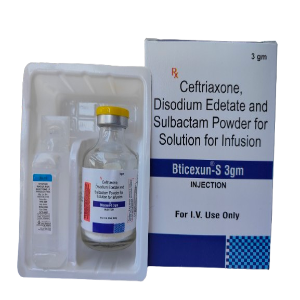
Ceftriaxone Sodium 1000 mg, Sulbactam 500mg and Disodium Edetate (EDTA) 37 mg for Injection/ Infusion Ceftriaxone Sodium 2000 mg, Sulbactam 1000mg and Disodium Edetate (EDTA) 74mg for Injection/ Infusion
1. Ceftriaxone Sodium:
Class: Cephalosporin antibiotic (third-generation)
Mechanism: Ceftriaxone works by inhibiting bacterial cell wall synthesis, leading to cell death. It is effective against a wide range of Gram-positive and Gram-negative bacteria.
Indications: Used to treat infections such as respiratory tract infections, urinary tract infections, skin infections, meningitis, gonorrhoea, and other serious infections.
Administration: Ceftriaxone is typically given via intravenous (IV) or intramuscular (IM) injection.
2. Sulbactam:
Class: Beta-lactamase inhibitor
Mechanism: Sulbactam is often combined with antibiotics like ceftriaxone to prevent bacterial resistance. It works by inhibiting beta-lactamase enzymes, which some bacteria produce to destroy the antibiotic before it can be effective.
Indications: Used to enhance the effectiveness of beta-lactam antibiotics like ceftriaxone, especially against beta-lactamase-producing bacteria.
3. Disodium Edetate (EDTA):
Class: Chelating agent
Mechanism: EDTA binds to metal ions (such as calcium or magnesium) that may interfere with the antibiotic’s efficacy. In some formulations, EDTA may be used to improve the stability of the medication and reduce side effects associated with metal ions.
Indications: While not directly antibacterial, EDTA is included in some injectable medications to enhance stability and reduce adverse reactions.
Uses of the Combination:
This combination is often used in the treatment of severe bacterial infections. It helps treat infections by:
Ceftriaxone providing a broad spectrum of antibacterial action.
Sulbactam protecting ceftriaxone from bacterial resistance mechanisms.
EDTA contributing to the stability of the preparation.
Common Indications:
Severe infections where broad-spectrum antibiotics are needed, including:
Respiratory infections (e.g., pneumonia)
Intra-abdominal infections (Peritonitis)
Skin and soft tissue infections
Urinary tract infections
Bone and joint infections
Meningitis (Brain)
Sexually Transmitted Infection (Syphill & Gonorrhoea)
Low White Blood Cells (Neutropenia)
Dosage & Administration:
The usual dosing schedule for adults is 1–2 grams of ceftriaxone, combined with 0.5 -1 gram of sulbactam, administered via IV or IM. The exact dosage and infusion time will depend on the type and severity of the infection being treated.
Infusion may be required for specific infections, and infusion rates and duration should be followed per medical guidelines.
Usual Dose:
For mild to moderate infections: 1 to 2 grams of the combination (which typically includes 1g of ceftriaxone, 0.5-1 gram of sulbactam, and 37-64 mg of EDTA) every 12 to 24 hours.
For severe infections: The dose may be increased up to 4 grams per day, typically divided into two doses (1 to 2 grams every 12 hours).
Maximum Dose: Usually, up to 4 grams daily, depending on the infection’s severity and the patient’s condition.
Usual Dose:
For children: The dosage is generally based on the child’s weight, typically 50-100 mg/kg/day, divided into two doses.
For severe infections: A higher dose of up to 200 mg/kg/day may be used, divided into multiple doses.
Bticexun-S the combination of Ceftriaxone Sodium, Sulbactam, and Disodium Edetate (EDTA) is commonly used in injectable or infusion form for the treatment of bacterial infections. Here’s an overview of the components:
Reviews
There are no reviews yet.